
Fujita Kanko (9722)
A ¥115bn hotel company with ¥80bn of hidden assets—and a private-equity owner pushing from inside

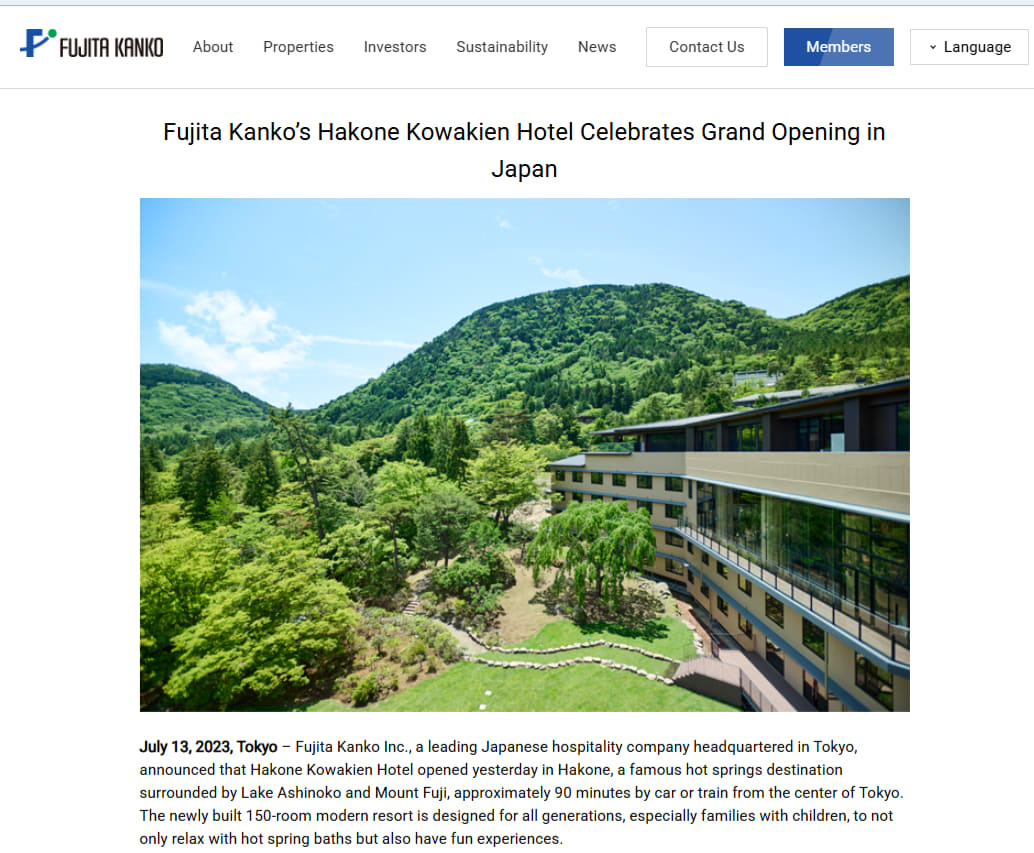
Fujita Kanko operates 34 hotels under the Washington Hotel, Hotel Gracery and Hotel Tavinos brands, mainly in Japan, together with Hotel Chinzanso Tokyo and the Hakone Kowakien resort. The company has a market capitalization of ¥115.6 billion and trades at 10.4x forward EV/EBIT, with a 16.8% EBIT margin in FY2025. (All prices and multiples are as of the close on July 22, 2026, when Fujita Kanko last traded at ¥1,930.)
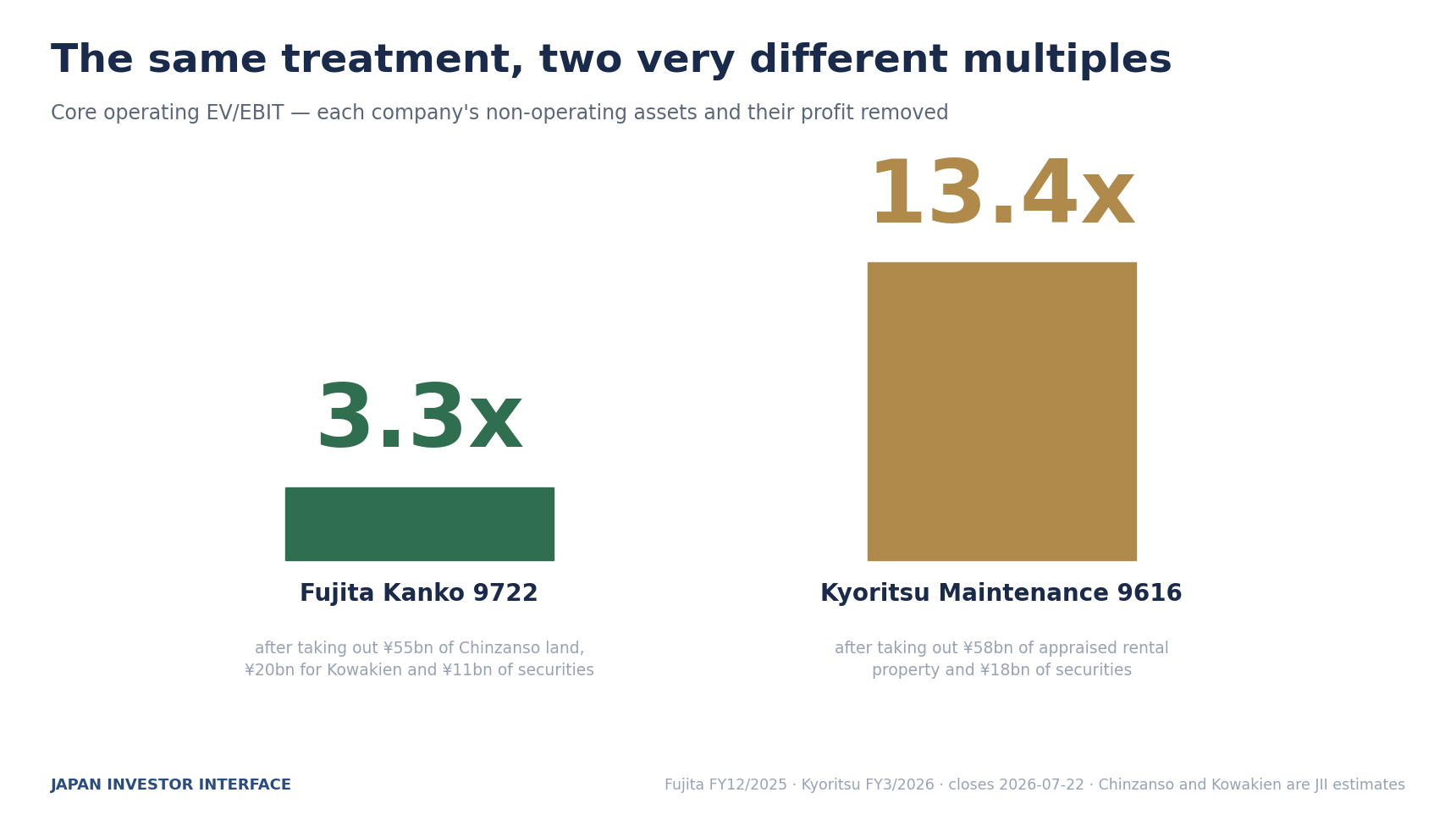
That headline valuation includes land beneath Hotel Chinzanso that has been carried at historical cost since 1955, the Hakone resort, and ¥11.3 billion of investment securities. After valuing those assets separately and removing the profit they generate, Fujita Kanko’s main hotel chain is valued at about 3.3x EBIT.
The reason to look more closely is that NSSK, a private-equity firm, bought 25% of the company in February 2026 at ¥2,603 per share, well above the current price. NSSK can nominate two directors, and one has already joined the board. NSSK now has both the incentive and a route to push for changes that could increase the company’s value.
The investment case rests on three points: 1. The assets outside WHG account for most of the company’s market value. 2. NSSK bought 25% of Fujita Kanko at a price well above the current share price and now has board and consent rights. 3. Fujita Kanko is also working more closely with Washington Hotel Co., Ltd. to share customers, raise occupancy, increase direct bookings, and possibly deepen the relationship further over time.
Fujita Kanko owns valuable land, investment securities, and a profitable resort business. Once we give those assets a separate value, the market appears to be paying only 3.3x EBIT for the company’s main hotel chain.
1. Most of the market value is supported by assets outside WHG
Hotel Chinzanso sits on approximately 49,000 square metres of land in Sekiguchi, Bunkyo-ku. Fujita Kanko carries the land at only ¥49 million, or about ¥1,000 per square meter.
Published residential land prices in Bunkyo-ku average ¥1.45 million per square metre for 2026. The Sekiguchi district averaged ¥1.22 million in 2025, after rising 12.2% that year. Rolling that figure forward gives an estimated ¥1.37 million per square meter.
Applying ¥1.37 million to the whole site gives a gross value of about ¥67 billion. The property is subject to development restrictions, and few buyers could purchase a site of this size. We therefore tentatively value Hotel Chinzanso and its land at ¥55 billion.
Hakone Kowakien covers approximately 795,000 square metres. Most of the land is forested slope inside a national park, so we do not value it as ordinary development land. We tentatively value the resort business at ¥20 billion, equal to 8.6x FY2025 EBITDA.
Fujita Kanko owns a further ¥11.3 billion of investment securities and has ¥8.8 billion of net debt.
The calculation is:
Hotel Chinzanso and its land: ¥55.0 billion
Hakone Kowakien resort: ¥20.0 billion
Investment securities: ¥11.3 billion
Net debt: negative ¥8.8 billion
The total is ¥77.5 billion. That is about 67% of Fujita Kanko’s ¥115.6 billion market capitalization before valuing WHG.
The remaining value assigned to WHG is approximately ¥38.1 billion. After removing the operating profit earned by Hotel Chinzanso and Hakone Kowakien, WHG has about ¥11.4 billion of EBIT. The market is therefore valuing WHG at about 3.3x EBIT.
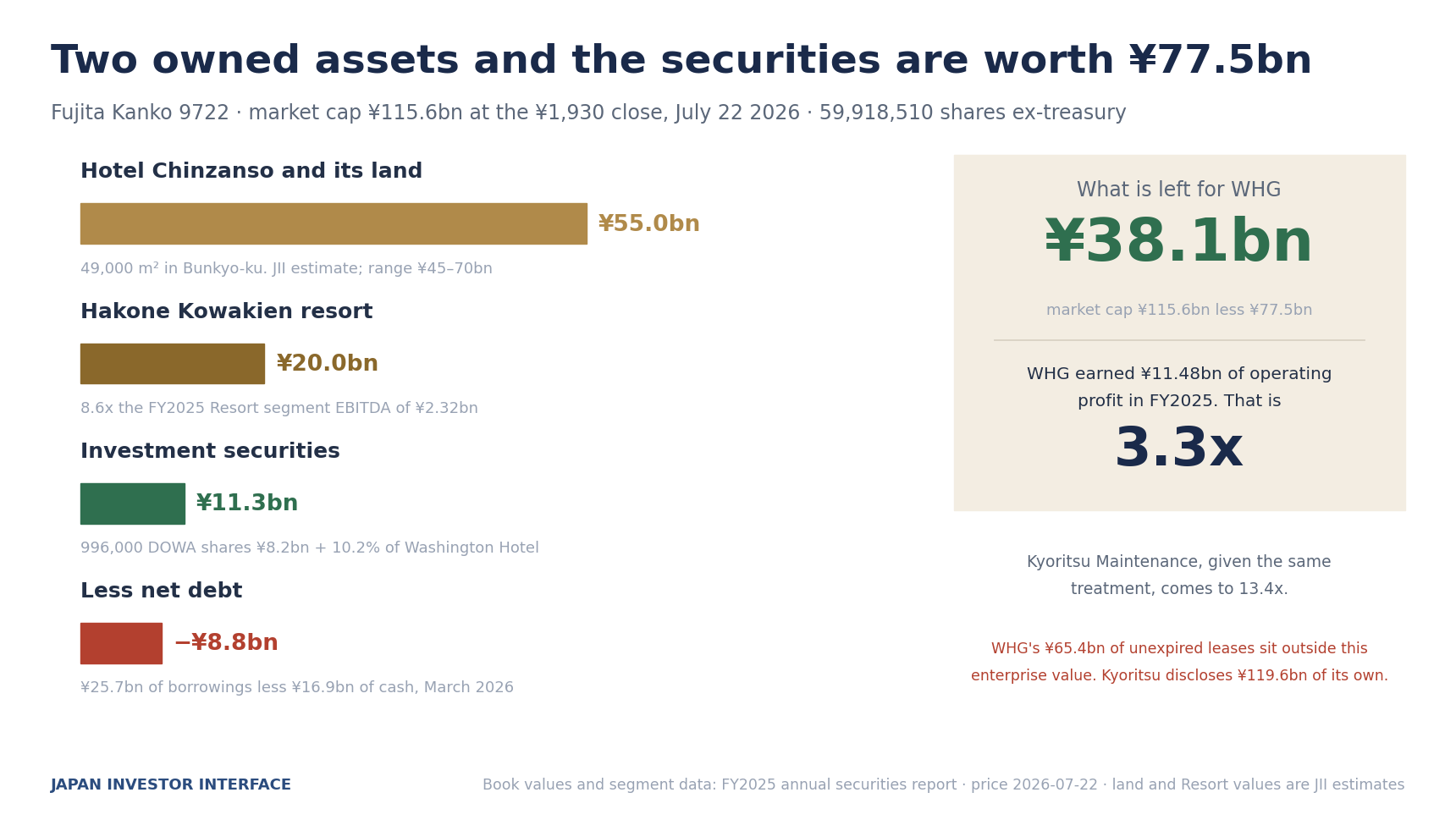
WHG rents all 34 of its hotels, and Fujita Kanko still has ¥65.4 billion of future rent payments under contracts that cannot be cancelled. Those payments are not counted as debt in the 3.3x EV/EBIT calculation. The business is therefore not as cheap as 3.3x would suggest on its own.
Kyoritsu Maintenance is the closest listed comparison. After removing its investment securities, rental property, and the income generated by those assets, Kyoritsu’s remaining business trades at about 13.4x EBIT.
Kyoritsu also relies heavily on leases. It discloses ¥119.6 billion of lease obligations, compared with Fujita Kanko’s ¥65.4 billion. Fujita Kanko’s obligations are larger relative to revenue, at 80% compared with 43% for Kyoritsu. This supports some valuation discount, but the gap between 3.3x and 13.4x remains large.
2. NSSK bought 25% at a much higher price and now has board influence
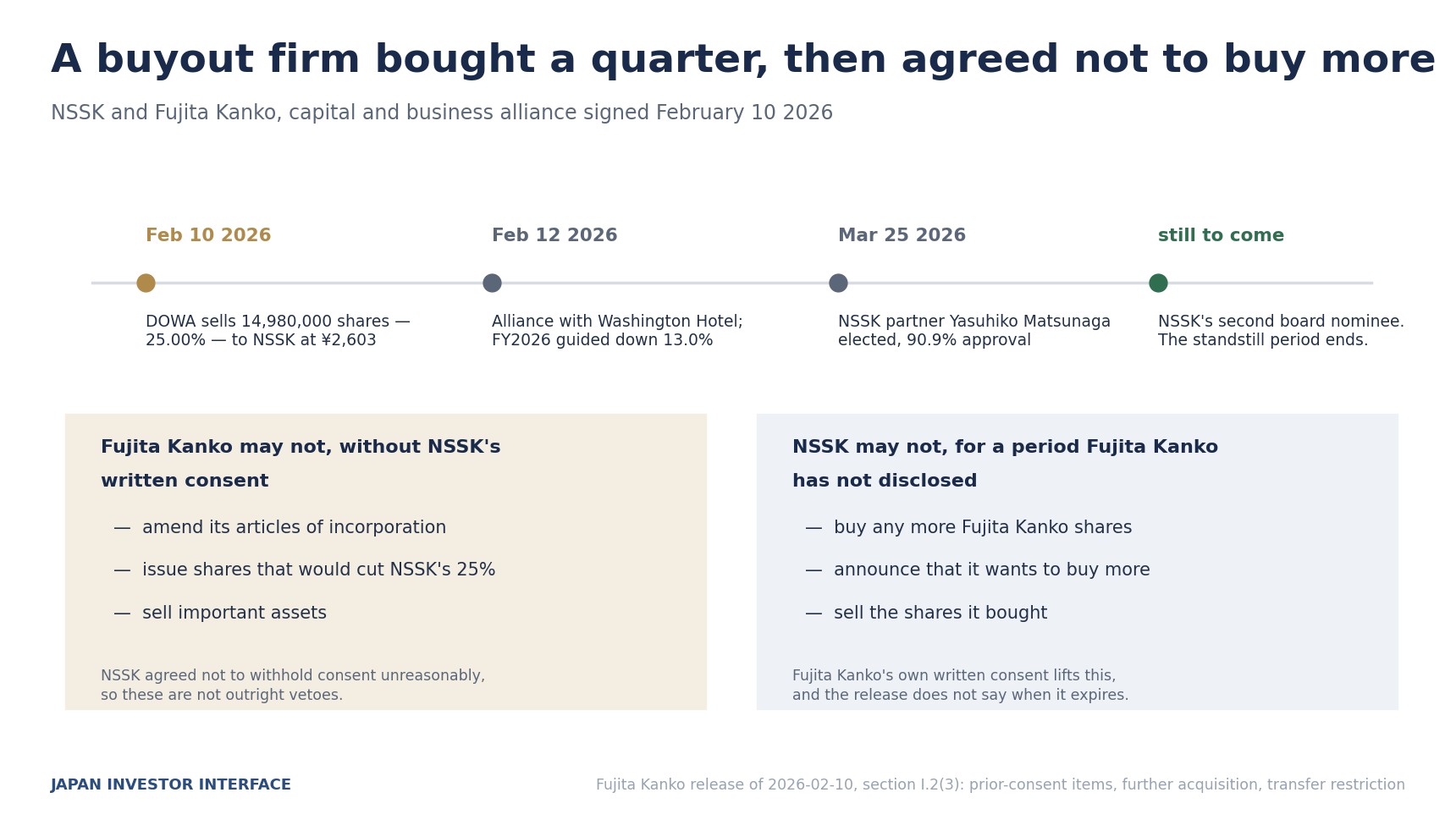
On February 10, 2026, NSSK, a buyout firm, bought 14.98 million Fujita Kanko shares from DOWA Holdings. It paid ¥2,603 per share for a 25% stake, excluding treasury shares. Since then, Fujita Kanko’s share price has fallen by about 26%, leaving NSSK roughly ¥10 billion below its purchase price on paper.
NSSK did not buy the stake as a passive investment. As part of the transaction, it received the right to nominate two directors. One of its nominees joined the board in March, and NSSK still has the right to nominate a second.
It also received consent rights over several important decisions. Fujita Kanko needs NSSK’s approval before changing its articles, issuing shares that would dilute NSSK’s 25% stake, or selling important assets. NSSK agreed not to withhold its consent unreasonably, so these rights do not amount to a full veto.
In return, NSSK accepted restrictions on what it can do with its shares. For an undisclosed period, it cannot buy more shares, announce that it intends to do so, or sell its existing stake. Fujita Kanko can remove these restrictions by giving written consent.
This leaves NSSK in an unusual position. It owns a large stake, the share price is well below what it paid, and it cannot currently buy or sell. Its main way to improve its return is therefore to influence the company through the board.
That influence could lead to better capital allocation, clearer disclosure of asset values, hotel acquisitions, asset sales, or changes to the company’s ownership structure. NSSK has previously taken listed companies private or proposed transactions involving listed companies, so a future buyout of Fujita Kanko is possible. However, NSSK cannot make such a move while the current restrictions remain in place.
The main points to watch are whether NSSK’s second nominee is elected, whether Fujita Kanko discloses how long the restrictions will last, and whether the company changes how it uses its assets and capital after NSSK’s entry.
3. The Washington Hotel relationship is becoming more important
On February 12, Fujita Kanko signed a business alliance with Washington Hotel Co., Ltd. (4691.T), a separate listed company that is not part of WHG or the NSSK transaction.
The two hotel networks complement each other. WHG is stronger in eastern Japan, while Washington Hotel has a larger presence in western Japan. Together, they operate 76 hotels with about 20,000 rooms.
The alliance is designed to send customers between the two networks, raise occupancy, and increase direct bookings. Direct bookings are more profitable because the hotels avoid commissions paid to online travel agents. Fujita Kanko does not disclose WHG’s direct-booking ratio, so occupancy and any future disclosure of that figure will be important measures of progress.
On April 1, the two companies linked their loyalty programs. Members could then use roughly 90 hotels across both groups, giving the combined network access to about 1.5 million members. This required little capital, and any benefit should appear mainly through higher occupancy and more direct bookings.
On May 1, Fujita Kanko raised its stake in Washington Hotel from 7.1% to 10.2%. The purchase price was not disclosed. At a tenth of the shares, Fujita Kanko is now a significant shareholder. That is more than an ordinary business partner.
The next question is whether it buys more. A move toward 20% would deepen the relationship and could eventually lead to consolidation, although neither company has announced such a plan.
Washington Hotel’s shares have risen by 86% since the day before the NSSK transaction, while Fujita Kanko’s have fallen by 26%. Stronger earnings and a doubled dividend explain part of the rise, but not all of the timing. The shares began moving in early April, before the results were announced in mid-May.
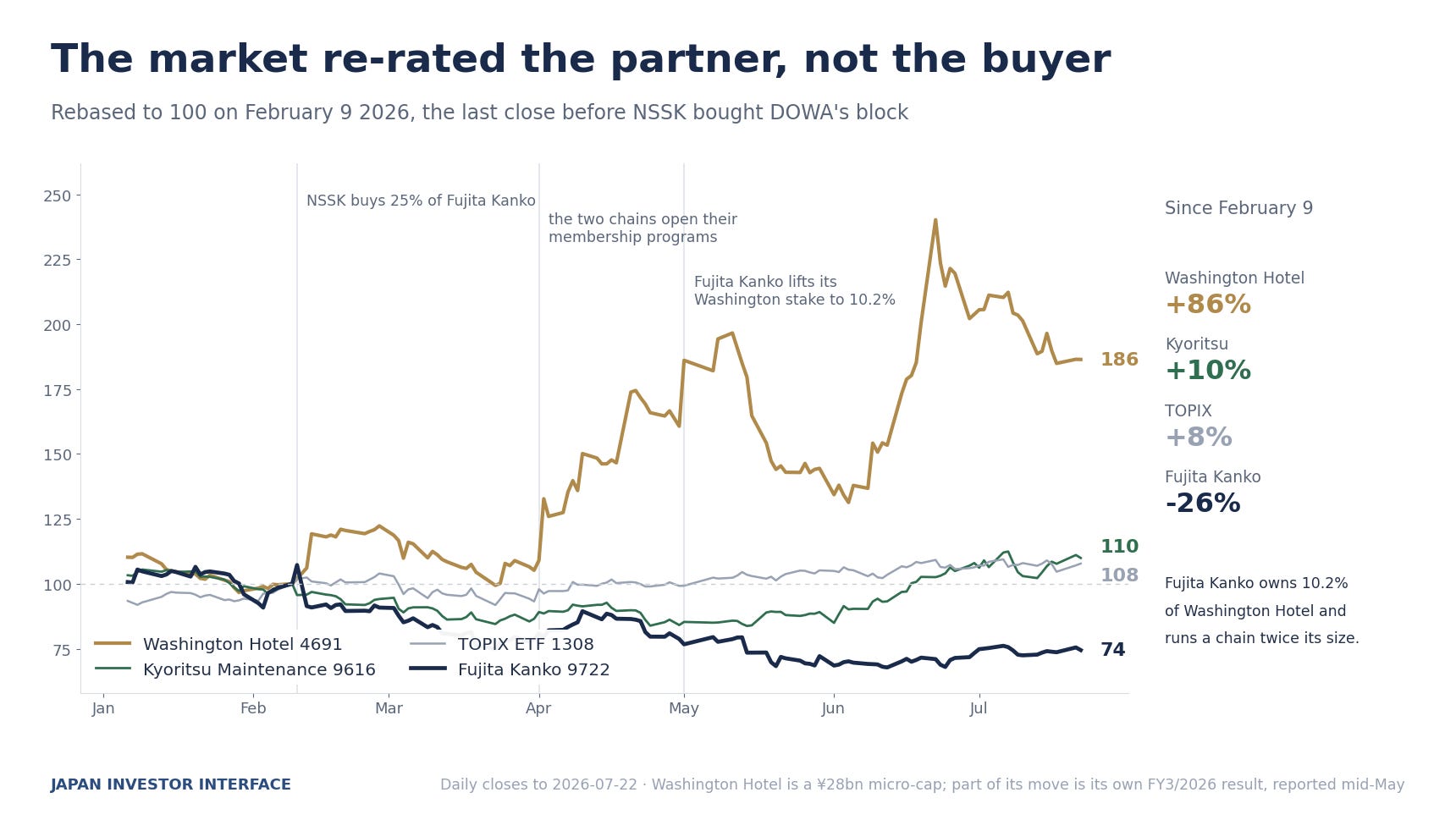
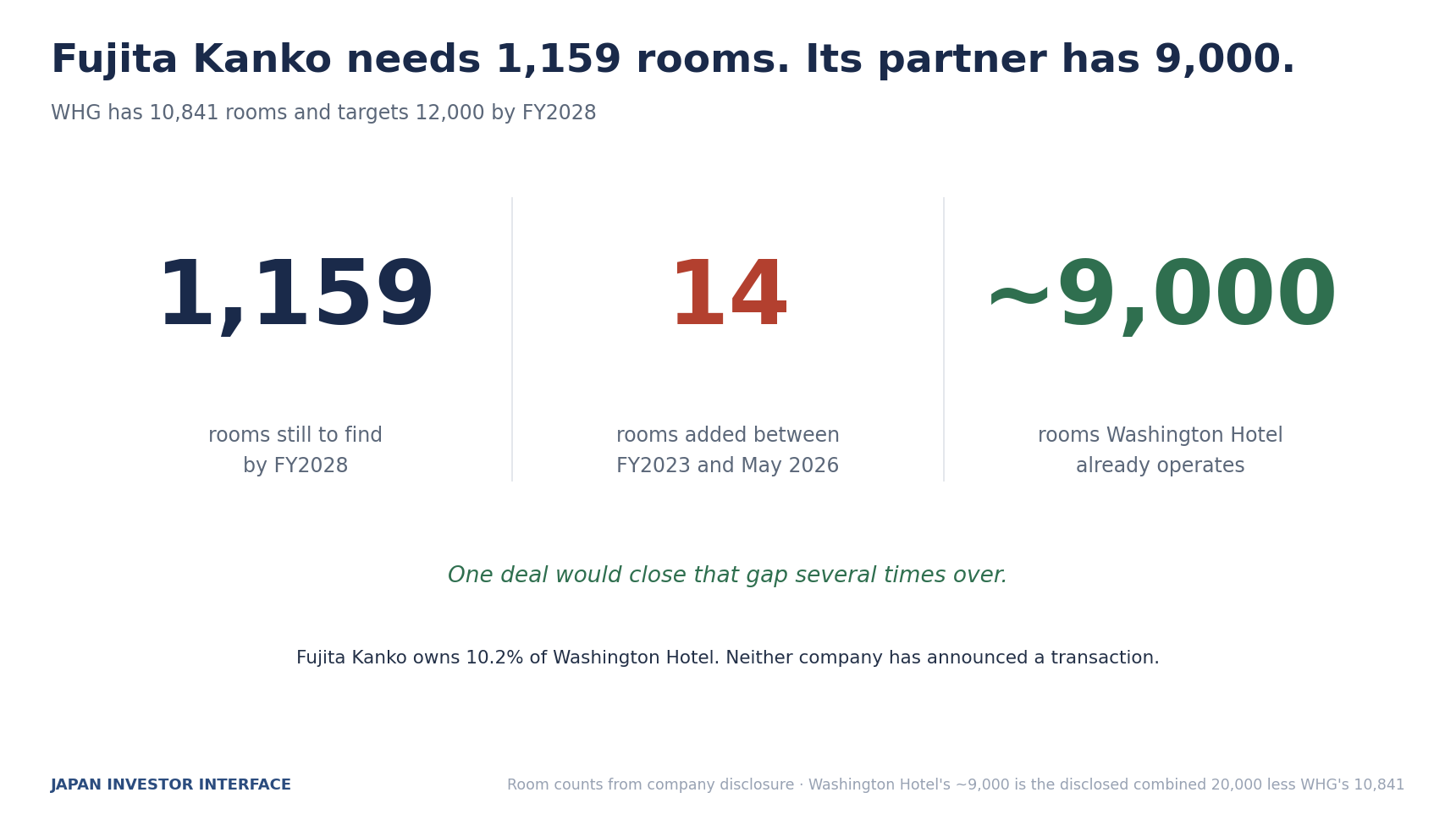
Washington Hotel is a small company with a thin free float. Part of the rise could therefore reflect limited liquidity, not a coming transaction. The more important point is strategic. Fujita Kanko has 10,841 WHG rooms and wants to reach 12,000 by FY2028, but it added only 14 rooms between FY2023 and May 2026. It is unlikely to close that gap by opening hotels one at a time. Washington Hotel already operates a complementary network, making it a natural route for Fujita Kanko to add rooms more quickly. Neither company has announced a larger transaction, but Fujita Kanko’s 10.2% stake makes that possibility worth watching.
Conclusion
A financial screen values Fujita Kanko at 10.4x forward EV/EBIT. That figure does not reflect the current value of the Hotel Chinzanso land, which remains recorded at its historical cost.
After valuing Hotel Chinzanso, Hakone Kowakien, and the investment securities separately, subtracting net debt, and removing the operating profit earned by the two hotel assets, WHG is valued at about 3.3x EBIT.
NSSK bought 25% of Fujita Kanko at ¥2,603 per share and is now about 26% below its purchase price. It has the right to nominate two directors, one of whom has already joined the board, and it has consent rights over important decisions.
Fujita Kanko has also formed an operating alliance with Washington Hotel, opened the two membership programs to each other, and increased its ownership to 10.2%.
The main points to follow are WHG occupancy, any disclosure of the direct-booking ratio, NSSK’s second board appointment, the terms of NSSK’s share-purchase restriction, and any further increase in Fujita Kanko’s Washington Hotel stake.
Related Links
Our methodology: https://jpinv.com/en/compounders/methodology/
Our watch universe: https://jpinv.com/en/compounders/universe/
View all compounder profiles: https://jpinv.com/en/compounders/profiles/
Capital allocation signals feed: https://jpinv.com/en/compounders/feed/
Editorial: What I Am Looking for If the AI Boom Unwinds
I have become more cautious about global equities. Much of the recent boom assumes that artificial-intelligence spending will keep rising for years.
The question is who this investment ultimately serves. Some of it clearly serves customers. Companies use AI to write software, analyse documents, automate support and improve products. But much of the spending also comes from technology companies training the next generation of models.
This creates a circular system. Hyperscalers build data centres, which buy expensive chips, which train models that require still more data centres and chips. The companies funding the infrastructure are often closely tied to those creating the demand.
The cycle can continue while investors believe future revenue will justify the spending. My concern is what happens when that belief weakens. Chinese companies are producing increasingly capable models, which may reduce the scarcity value of frontier AI. Oil prices, long-term yields and gold are also rising. That makes me less comfortable owning businesses whose valuations depend on distant, uncertain profits.
This does not mean there is nothing to invest in. It changes what I am looking for.
I am spending more time on ownership structures, industry consolidation and businesses with genuine pricing power.
Food trays: strong pricing, heavy reinvestment
In my previous post, I said I would examine food trays. The initial case was simple: prices are rising, and FP Corporation, or FPCO (7947.T), is the industry leader.
FPCO raised prices three times after October 2021 and announced another increase of at least 20% from June 1, 2026, following sharp increases in raw-material and energy costs.
Its main advantage is its recycling network. FPCO collects used trays, converts them into raw material and uses that material to make new trays. Scale gives it access to more recycled input and reduces its dependence on newly produced plastic.
The business is strong, but the equity story is less clean. FPCO still requires heavy investment in factories, distribution centres and recycling facilities. Investment cash outflow reached ¥16.6 billion in FY2026, and another factory and distribution centre were announced in April.
Much of the cash the company generates must therefore be reinvested. I found the pricing story more attractive than the stock at its current valuation and balance-sheet position.
Nankai Tatsumura: the discount reflects control
I have also been studying Nankai Tatsumura Construction (1850.T), an Osaka-based builder trading at slightly above 2x EV/EBIT by my calculation.
The low valuation does not appear to reflect a weak business. Nankai Electric Railway owns roughly 62%, leaving minority shareholders with little influence over operations or capital allocation.
That is the central problem with many listed subsidiaries. A company may look cheap, but minority investors cannot assume that its value will be distributed to them. The parent can retain control without buying the remaining shares or improving shareholder returns.
The operating environment is favourable. Osaka is considering further metropolitan restructuring, while local and national governments are promoting its role as a backup or secondary capital. These initiatives are not yet a single approved construction programme, but they point towards continued spending on transport, redevelopment and infrastructure.
Construction demand alone, however, will not remove the discount. Nankai Electric could acquire the remaining shares, or it could improve dividends, buybacks and governance enough to justify the listing.
Tokyo Stock Exchange pressure makes both outcomes more plausible. Until one occurs, the low multiple may simply be the price of owning a minority stake in a controlled company.
Sugar: waiting for alliances to become consolidation
The Japanese sugar industry offers another version of the same idea.
Sugar refiners are mature businesses with established facilities, essential products and relatively stable earnings. The sector is also moving towards fewer and closer corporate groupings.
Ensuiko Sugar Refining (2112.T), for example, trades at around 7x EV/EBIT by my calculation.
The key question is not simply whether Ensuiko is cheap. It is whether the relationships around it eventually lead to a transaction.
Daito Sugar acquired a substantial Ensuiko stake from Mitsubishi Corporation and placed a senior executive in Ensuiko’s leadership. Fuji Nihon has also formed an alliance with Ensuiko, formally announced in October 2025.
These relationships may remain commercial. The companies could cooperate in purchasing, production or distribution while remaining separately listed.
But sugar refining is a scale business in a mature market. Maintaining several listed companies, management teams and production networks may become increasingly difficult to justify. The logical endpoint is deeper integration, even if the timing and structure remain uncertain.
That is the kind of situation I now find more attractive. Returns do not depend on investors paying ever-higher multiples for distant growth. They can come from a specific change in ownership, industry structure or capital allocation.
Read full writeups here: FPCO, Ensuiko, Nankai Tatsumura.